
Condition Guide
Back Pain
Back pain can come from the spine, discs, joints, nerves, muscles, or nearby structures. The location and pattern of pain can provide clues, but symptoms alone do not always identify the source. A physician-led evaluation helps connect your symptoms, examination findings, medical history, and, when appropriate, imaging before treatment options are discussed.

Back Pain Is Not One Diagnosis
Back pain may stay in the lower back, travel into the buttock or leg, or change with standing, sitting, walking, bending, or lifting. A careful evaluation helps determine which findings matter and which may be incidental.
Overview
What is back pain?
Back pain describes discomfort anywhere along the lower, middle, or upper back. It may follow a specific event such as a lift or a fall, or it may build gradually with no clear starting point. Some episodes settle with time and activity changes. Others persist, change character, or begin to limit walking, work, or sleep — and those are the situations where identifying the likely source becomes most useful.
Symptom Pathways
What this pain may feel like
- Local low-back pain
- Discomfort that stays across the lower back and may feel deep, stiff, or band-like.
- Pain into the buttock or hip
- Pain that spreads toward the pelvis, buttock, or side of the hip without clearly travelling below the knee.
- Leg pain, numbness, or tingling
- Symptoms that travel down the leg, sometimes with pins and needles or a change in sensation.
- Pain or heaviness with standing or walking
- Symptoms that build with upright activity and often ease with sitting or leaning forward.
- Pain after an injury
- Pain that began with a fall, lift, collision, or other identifiable event.
- Pain that persists despite prior treatment
- Symptoms that continued after therapy, medication, injections, or previous surgery.
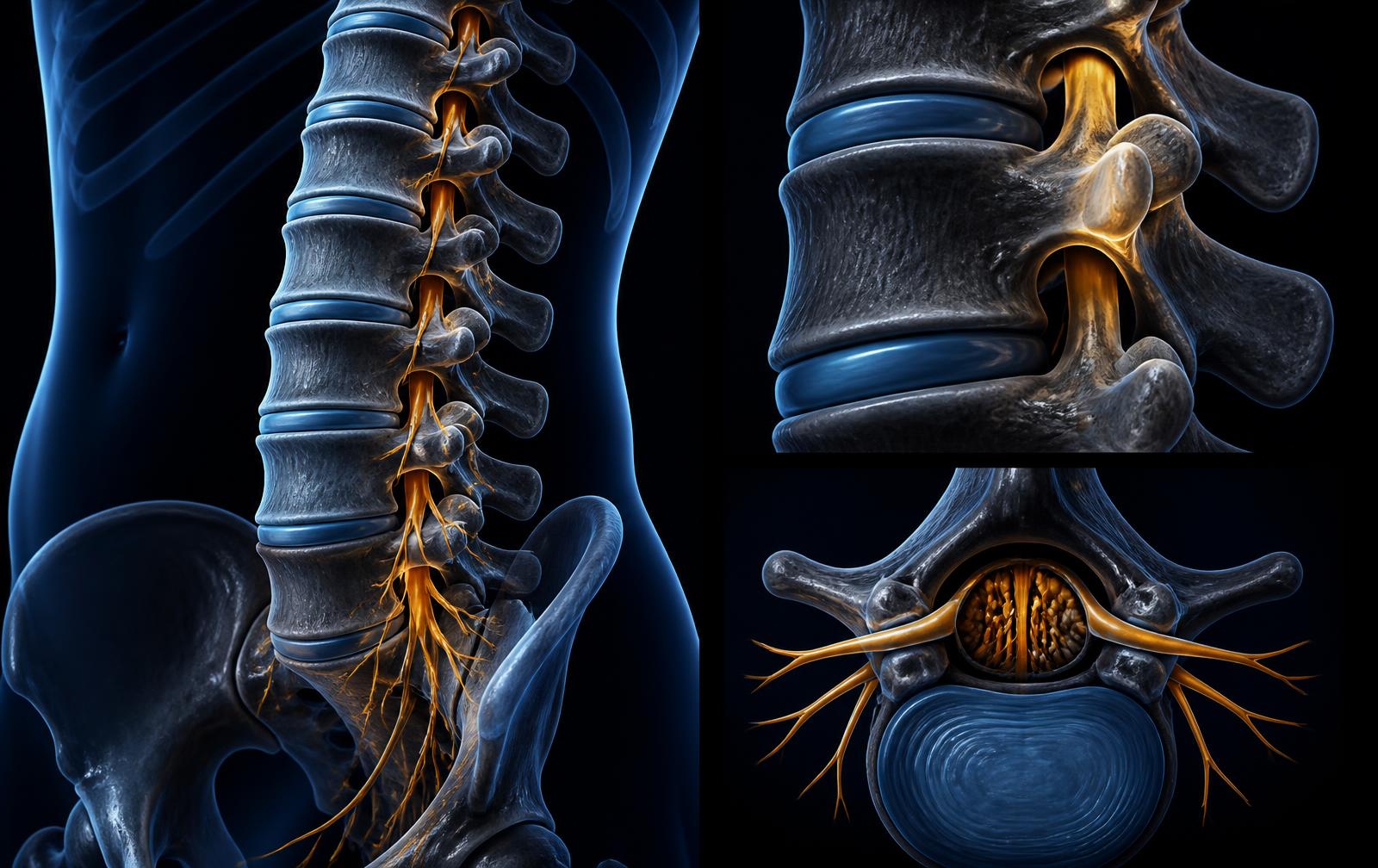
Anatomy
When Might the Pain Be Coming From Somewhere Else?
Pain is not always felt where it starts. Hip conditions can produce buttock or groin symptoms that resemble spine pain, and spine conditions can produce hip or leg symptoms. Overlapping sources are common, particularly when symptoms have been present for a long time. This is one reason examination findings and history carry as much weight as imaging.
Possible Contributors
Common contributors and possible causes
Several structures can contribute to back pain, sometimes at the same time. None of the items below identifies the cause of your pain — they describe possibilities a physician considers during an evaluation.
- 01
Disc-related pain
Changes in a disc may irritate nearby tissue or nerves. Imaging changes are common and do not always explain symptoms.
- 02
Facet-joint pain
The small paired joints at the back of the spine can become painful, often with extension or rotation.
- 03
Nerve irritation or sciatica
Irritation of a nerve root can produce pain, numbness, or tingling that travels into the leg.
- 04
Spinal stenosis
Narrowing around the nerves may relate to heaviness or leg symptoms that build with standing and walking.
- 05
Vertebral or compression-related pain
Bone-related pain, including compression fractures, can present as focal or activity-limiting back pain.
- 06
Muscle and soft-tissue contributors
Muscles, tendons, and fascia can be painful themselves or as a response to another problem.
- 07
Sacroiliac-region pain
Pain around the joint between the sacrum and pelvis can be felt low in the back or in the buttock.
- 08
Referred pain from the hip or other structures
Hip, pelvic, or abdominal structures can produce symptoms that feel like back pain.
Physician-Led Evaluation
How Back Pain Is Evaluated
Your physician may consider how the pain began, what makes it better or worse, whether it travels, how it affects walking or daily activity, what treatments you have tried, and what the examination shows. Imaging may be useful when it helps answer a specific clinical question.
- History: onset, pattern, progression, and prior episodes.
- Aggravating and easing positions or activities.
- Physical examination including movement, strength, sensation, and reflexes.
- Functional goals — what you want to be able to do again.
- Prior treatment and how you responded to it.
- Imaging or other testing when it would change the plan.
Care Options
Treatment options that may be considered
Treatment depends on the diagnosis, your history, your goals, and the findings from a physician-led evaluation.
Come Prepared
Questions to discuss with a physician
- 01Where does the pain begin and where does it travel?
- 02Does standing, sitting, walking, or bending change it?
- 03What treatments have already been tried?
- 04Do the imaging findings match the symptoms and examination?
- 05What are the reasonable alternatives before a procedure is considered?
- 06What would recovery involve?
Questions Patients Ask
Frequently asked questions
Does an abnormal MRI mean it is the source of my pain?
Not necessarily. Imaging often shows changes that are common with age and may not be responsible for symptoms. Findings are most useful when they line up with your history and examination.
Do I need imaging before my first appointment?
Not always. Bring any imaging or reports you already have. Whether new imaging is useful depends on what question needs to be answered.
Is surgery the only option if conservative care has not helped?
No. There is a range of options between conservative care and open surgery, and which of them are reasonable depends on the diagnosis. Treatment depends on the diagnosis, your history, your goals, and the findings from a physician-led evaluation.
Should I rest or stay active?
General guidance is that prolonged bed rest is rarely helpful, but the right level of activity depends on your situation. Stop any activity that worsens your symptoms and discuss questions with a qualified clinician.
Can back pain cause leg symptoms?
It can. Nerve irritation in the lower back may produce pain, numbness, or tingling in the leg — but leg symptoms can also come from the hip, knee, peripheral nerves, or circulation.
This page is for general education only. It does not diagnose your condition or replace an evaluation by a qualified clinician.
Related PainHealth Resources
Continue Learning
Stop any activity that worsens your symptoms and discuss questions with a qualified clinician.
Ready to understand what may be contributing to your pain?
Start a conversation with the PainHealth team about your symptoms, goals, prior treatment, and next steps.