
Condition Guide
Upper Limb Pain
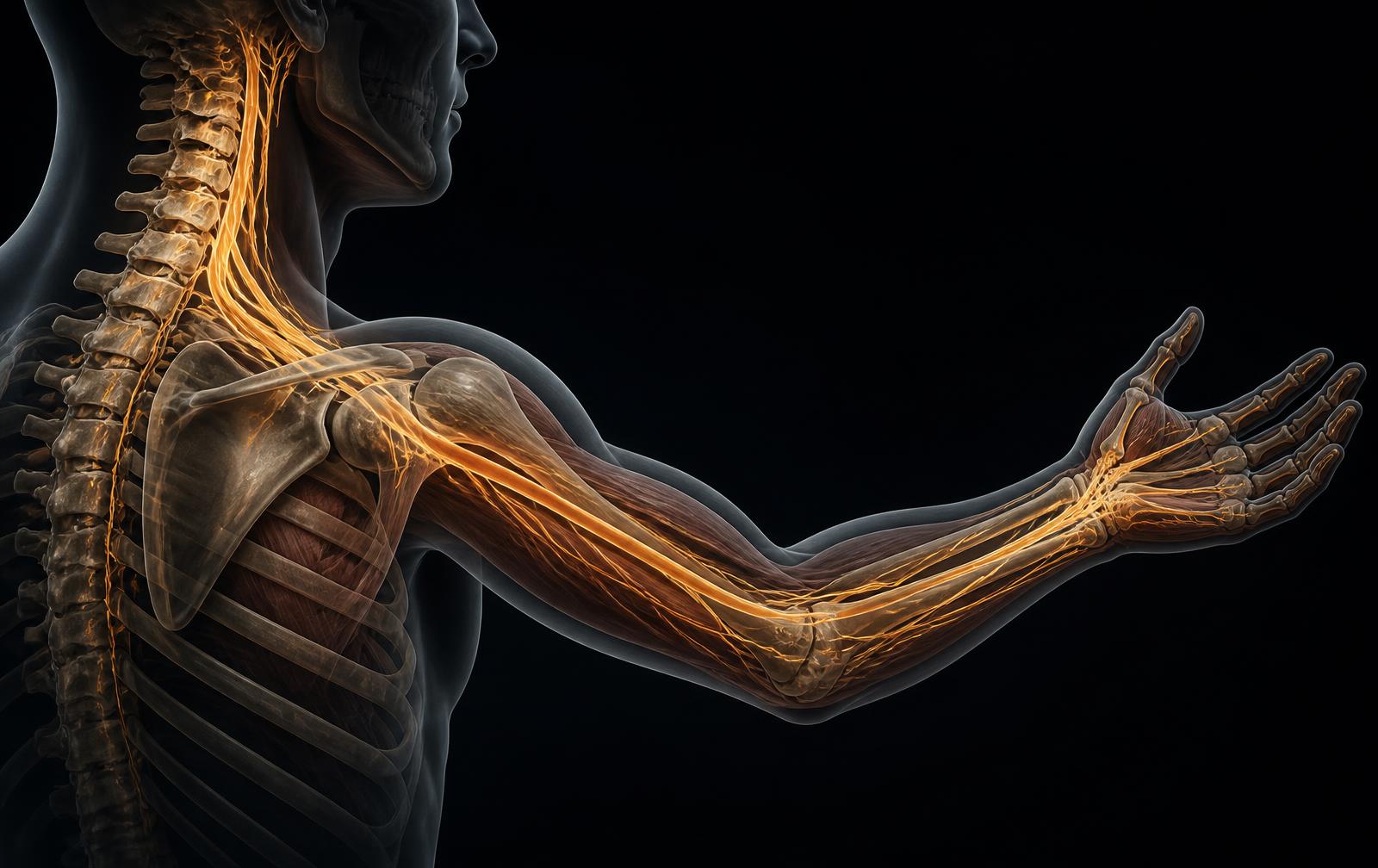
Pain in the shoulder, arm, elbow, wrist, or hand may come from local tissues, joints, nerves, or the neck. A careful evaluation helps determine whether symptoms are coming from the limb itself or being referred from elsewhere. Symptoms alone rarely settle that question.

Is the Source in the Neck or in the Arm?
Numbness in the hand, pain with reaching, or weakness in the grip can arise from local structures, from a peripheral nerve, or from the cervical spine. Separating those possibilities shapes everything that follows.
Overview
What is upper limb pain?
Upper limb pain covers symptoms from the shoulder to the fingertips. It may be mechanical — worse with specific movements or loads — or nerve-related, with numbness, tingling, or weakness. Work, sport, and repetitive activity frequently influence the pattern.
Symptom Patterns
What this pain may feel like
- Pain with reaching overhead
- Discomfort in the shoulder with elevation, often affecting dressing or lifting.
- Pain with gripping or lifting
- Elbow or forearm symptoms provoked by load.
- Numbness or tingling in the hand
- Altered sensation that may affect specific fingers.
- Pain travelling from the neck into the arm
- Symptoms that follow a line down the arm and may change with neck position.
- Weakness or dropping objects
- Difficulty maintaining grip or controlling the hand.
- Symptoms linked to repetitive activity
- Patterns that follow work tasks, keyboarding, tools, or sport.
Anatomy
When Neck Findings Matter
If neck movement changes the arm symptoms, or if numbness follows a nerve distribution, the cervical spine becomes part of the evaluation. Conversely, a neck imaging finding does not automatically explain arm symptoms — the examination has to agree.
Possible Contributors
Common contributors and possible causes
Possible contributors are considered together with the examination. Overlap between local and neck-related sources is common.
- 01
Shoulder joint or rotator-cuff-related pain
Pain with elevation, reaching, or lying on the shoulder.
- 02
Tendon or bursa irritation
Localised pain and tenderness that changes with load.
- 03
Elbow overuse
Pain around the elbow related to gripping and repetitive tasks.
- 04
Wrist or hand conditions
Joint or soft-tissue problems affecting grip and fine movement.
- 05
Carpal-tunnel-type nerve symptoms
Numbness or tingling in part of the hand, sometimes worse at night.
- 06
Cervical radiculopathy
Nerve root irritation in the neck can produce arm pain, numbness, or weakness.
- 07
Peripheral nerve irritation
A nerve may be irritated along its course below the neck.
- 08
Arthritis
Joint-surface changes in the shoulder, elbow, wrist, or hand.
- 09
Repetitive-use or work-related strain
Cumulative load can contribute to several of the patterns above.
Physician-Led Evaluation
How Upper Limb Pain Is Evaluated
Your physician looks at movement, strength, sensation, and how the neck influences the symptoms, alongside your work and activity history.
- Where the symptoms begin and how they travel.
- Shoulder, elbow, wrist, and hand movement testing.
- Grip strength and fine-motor function.
- Sensation mapping across the hand and fingers.
- Whether neck position changes the symptoms.
- Work, sport, and repetitive-use history.
- Imaging or nerve testing when it would change the plan.
Care Options
Treatment options that may be considered
Treatment depends on the diagnosis, your history, your goals, and the findings from a physician-led evaluation.
Come Prepared
Questions to discuss with a physician
- 01Does the pain begin in the neck or in the arm?
- 02Which fingers or areas feel numb or tingly?
- 03Does neck movement change the symptoms?
- 04Is there weakness or loss of grip?
- 05Is the pain related to work, sports, or repetitive use?
- 06What does the examination suggest?
Questions Patients Ask
Frequently asked questions
Can neck problems cause hand numbness?
Yes. Nerve roots in the neck supply the arm and hand, so cervical irritation can produce numbness or tingling in the hand.
How is carpal-tunnel-type numbness told apart from a neck problem?
The distribution of numbness, provocative testing, neck movement effects, and sometimes nerve testing all contribute to the answer.
Is shoulder pain always the rotator cuff?
No. Several structures around the shoulder can be painful, and neck-related referral is also possible.
Should I stop the activity that hurts?
Modifying the aggravating load is often useful. Stop any activity that worsens your symptoms and discuss questions with a qualified clinician.
Does weakness always mean nerve damage?
Not necessarily — pain itself can limit strength. New or progressive weakness, however, should be assessed promptly.
This page is for general education only. It does not diagnose your condition or replace an evaluation by a qualified clinician.
Related PainHealth Resources
Continue Learning
Stop any activity that worsens your symptoms and discuss questions with a qualified clinician.
Ready to understand what may be contributing to your pain?
Start a conversation with the PainHealth team about your symptoms, goals, prior treatment, and next steps.